
Harriman Criminal History Checks
A Harriman search should begin with the event. If Harriman Police responded, request the city incident or arrest report. If the matter is a city ordinance, traffic, or parking case, contact Harriman City Court. If an arrest led to county custody or a state criminal charge, move to the Roane County jail and trial-court records. TBI's repository is useful for a wider Tennessee personal review, but it will not supply the full city narrative or municipal court file.
- Identify the Harriman agency, approximate date, location, and record type.
- Submit a specific city request through Harriman's official form or police contact.
- Ask City Court about municipal citations, settings, payments, and dispositions.
- Check Roane County booking and court sources for custody or state-law prosecution.
- Use TBI only when the question calls for a broader Tennessee repository record.
Keep the identifiers tied to each layer. A Harriman incident number will not always match a county booking number or a General Sessions docket. For a felony, the preliminary case can also lead to a different Criminal Court number. Those links are built by comparing date, charge, identity, and court references, not by assuming one number follows the matter everywhere.
Harriman Record Request Form
Harriman's interactive public-record form is the city's strongest documented request channel. It asks for the requester's name, email, phone, and address; Tennessee citizenship; an uploaded Tennessee driver-license image; request type; a cost estimate or ceiling; delivery choice; a detailed description; signature; and date. The upload limit shown in the research was 10.6 MB. Because the form can change, read its current labels before submitting.
The official Harriman request form sets out the working fields and choices.
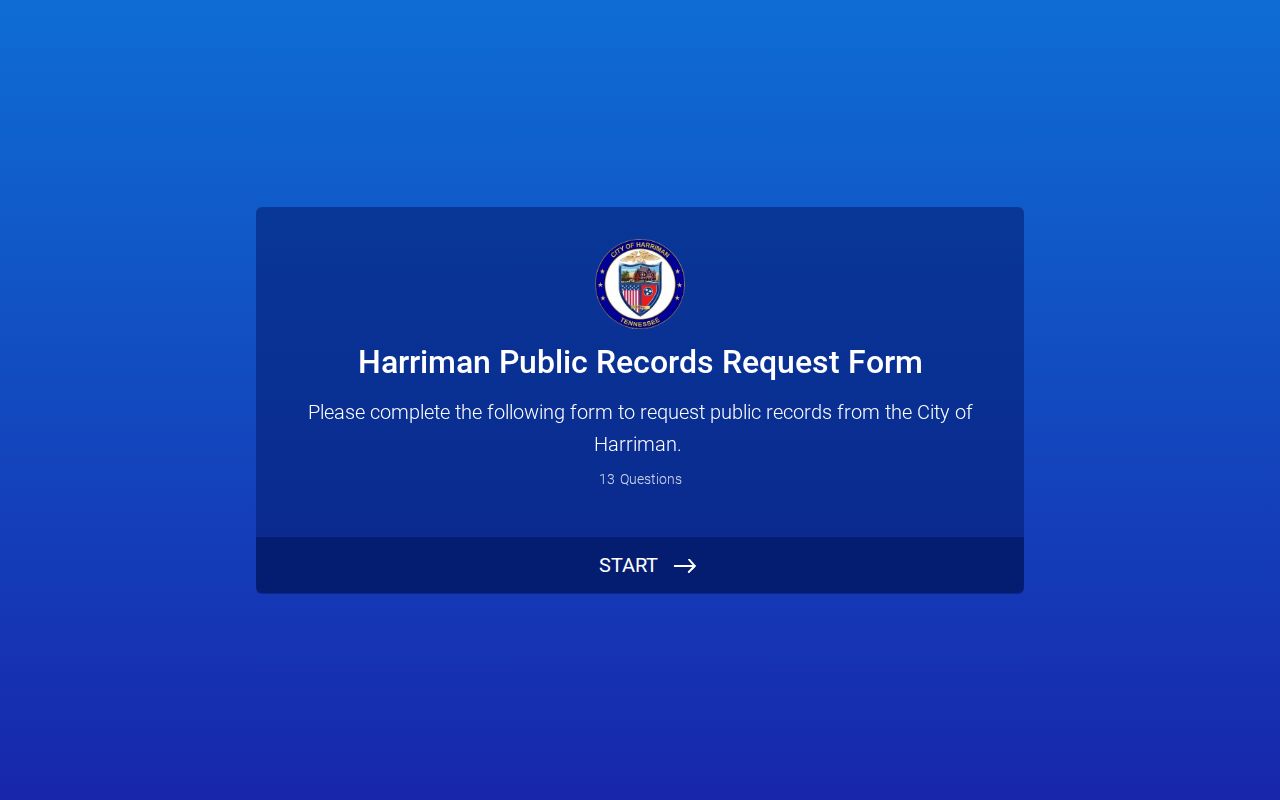
The screen makes clear that Harriman produces existing records. It does not require city staff to create a new timeline, analysis, or criminal-history summary from separate files.
| Form Field | Harriman Choice or Format | Why It Matters |
|---|---|---|
| Tennessee Citizen | Yes or No, with state ID upload | Supports the city's TPRA eligibility check |
| Request Type | Inspection or Copy/Duplicate | Distinguishes review from production of copies |
| Cost Approval | Estimate acceptance or spending ceiling | Controls work before costs exceed the stated amount |
| Delivery | On-site pickup, electronic, USPS First Class, or other | Tells the city how copies should be supplied |
| Description | Record type, timeframe, subject, and key words | Helps staff locate an existing Harriman file |
Records at Harriman Police Department
Harriman Police and City Court operate through City Hall at 408 N. Roane Street, Harriman, Tennessee 37748. The police nonemergency and court-question line is 865-882-3383. After-hours county dispatch is 865-354-8045. Counter hours are listed as Monday through Friday, 8 a.m. to 4:30 p.m. Use the nonemergency or request channel for routine record work, not emergency dispatch.
The official Harriman Police and City Court page combines local contact, jurisdiction, schedule, and payment details.
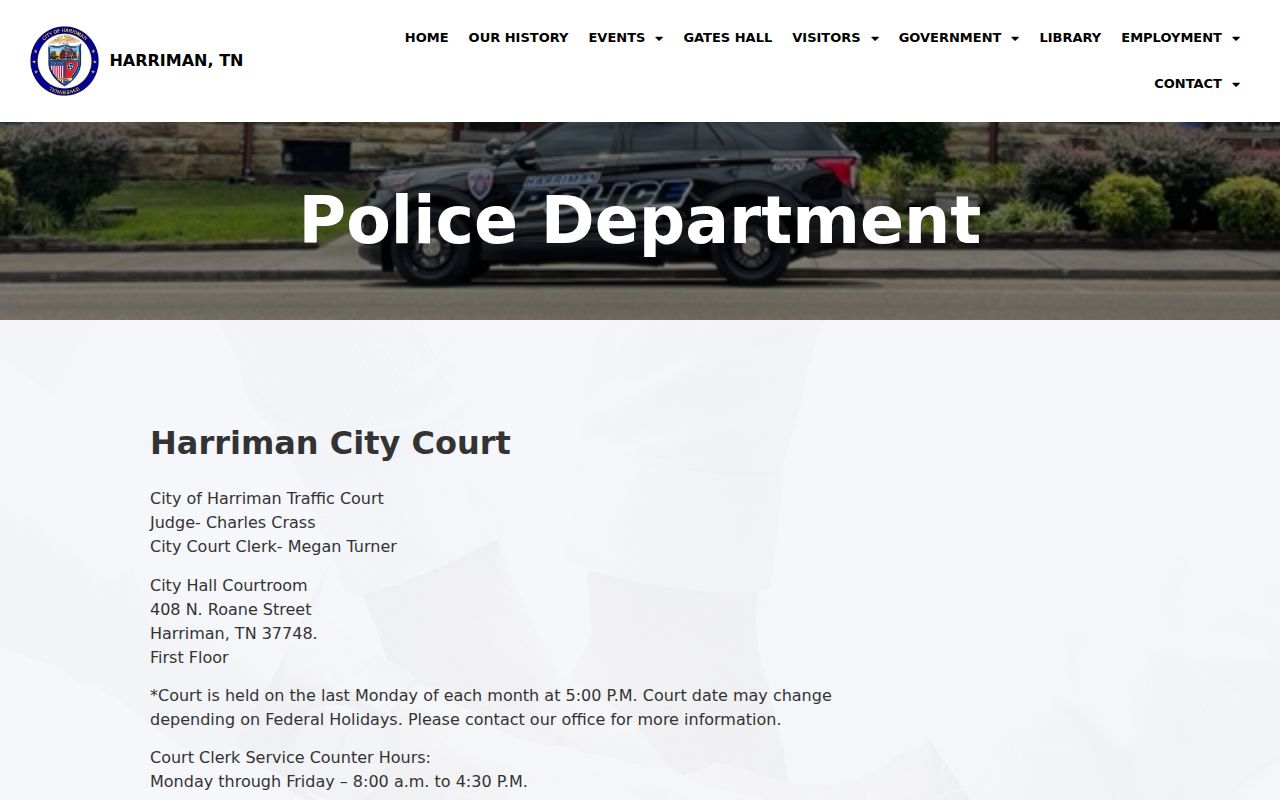
The city page is a direct access point, but it is not a public name-based police or court database. Request the particular Harriman record or call the clerk.
Harriman Police and City Court
408 N. Roane Street
Harriman, TN 37748
865-882-3383
After hours: 865-354-8045
Counter: Monday-Friday, 8 a.m.-4:30 p.m.
Harriman Inspection or Record Copy
Inspection and copies are separate choices on Harriman's form. Inspection means reviewing an available public record, usually at the custodian's office. The city states that inspection itself carries no fee and does not have to be requested in writing. A copy request asks Harriman to duplicate and deliver the record. Reasonable copy, labor, media, or mailing costs may apply.
The distinction helps when a file may be large. A requester can inspect first and select the pages that matter. Someone who already knows the exact incident number and needs an electronic copy can choose duplication and set a cost ceiling. Harriman offers on-site pickup, electronic delivery, USPS First Class, and an “Other” choice. Delivery depends on what the office can provide and any lawful restrictions on the record.
A cost ceiling is not the same as a fee waiver. It tells Harriman not to exceed a set amount without further approval. If the estimate is high, narrow the date range, record type, or requested attachments. That approach reduces search work without losing the core report.
Booking and Arrest Records in Harriman
An HPD arrest begins with a Harriman police record. The report can contain the event narrative, alleged legal basis, arrest time and place, officers, listed charges, and transport. When the person enters Roane County detention, jail staff create a distinct booking profile with admission data, custody charges, bond, and arresting agency. General Sessions then maintains the first state-court entries. The same event can therefore appear in several systems on different schedules.
For the city narrative, use Harriman's form or call police. For current or recent confinement, use the official Roane County inmate interface and the sheriff's 865-376-5582 line as a fallback. For a filed charge, search General Sessions. If a felony is bound over and indicted, check Criminal Court as well. The detailed county sequence is available through the Roane County arrest search.
A released person may no longer appear in a current-confinement view. Search the interface's recent admit and release options where available, then request historical booking data from the county custodian. Never treat disappearance from a current list as proof that no Harriman arrest occurred.
Harriman City Court Calendar
Harriman City Court usually meets on the last Monday of each month at 5 p.m. on City Hall's first floor. Federal holidays can change that date, so the clerk should confirm the live schedule. The court hears city ordinance and adopted-code matters, traffic cases, and parking matters. It does not replace Roane General Sessions or Criminal Court for state criminal prosecutions.
The city lists Judge Charles Crass and Clerk Megan Turner. Naming the current officeholder can help route a question, but the key record contact remains the City Court line. Ask for the citation number, scheduled date, plea or payment status, and municipal disposition as applicable. A court-calendar answer does not supply the police narrative, and police staff may not be able to state the final court outcome.
When the usual last Monday falls near a holiday, verify the date before travel or mailing a payment. A reset can also change an individual setting. Use the clerk's answer for the current case rather than relying only on the normal monthly pattern.
The Harriman Municipal Court File
A Harriman municipal file is centered on the city citation or ordinance charge. It may contain the citation, court settings, payment or plea entries, and the final city-court action kept by the clerk. Harriman allows a guilty payment before court in person or by mail. The city says it accepts cash, check, and money order, but not debit or credit cards. That local rule differs from Kingston's payment options and should be confirmed before sending funds.
| Court Name | Harriman City Court |
|---|---|
| Location | First floor, 408 N. Roane Street, Harriman |
| Case Types Heard | City ordinance, adopted-code, traffic, and parking matters |
| Record Channel | City Court Clerk by phone or counter; no public defendant-name search identified |
| Payment Methods | Cash, check, or money order; the city states no debit or credit cards |
| Schedule | Usually the last Monday monthly at 5 p.m., subject to holiday changes |
Payment is a legal choice, not a search tool. A person who wants to contest the citation should follow the court's appearance instructions. For record access alone, ask the clerk for the existing public file and any copy charge before ordering.
Harriman City Hall Record Context
Harriman incorporated in 1891 and is known as the “Town that Temperance Built.” Its municipal identity still matters to record routing. The city keeps its own police and ordinance files even though a custodial arrest or state-law prosecution can move into Roane County systems. A Harriman address on an incident does not make the county clerk the custodian of the police narrative.
City Hall is the municipal layer where the police, court, and request form converge. County booking and prosecution records remain separate even when the offices cooperate, so the record creator still controls the request route.
How Harriman Records Reach the County
An HPD report stays with Harriman. If the person is booked in Roane County, detention staff add a separate custody record. A state charge enters General Sessions for a warrant, citation, bond action, preliminary hearing, or misdemeanor case. A supported felony can proceed to the grand jury and Criminal Court. Arrest and disposition data sent through Tennessee's criminal-justice network can then become part of TBI's repository history.
Record flow: Harriman Police Department › Roane County detention and courts › Tennessee Bureau of Investigation
Timing matters. The county booking can appear before the public court record. The court's final result may arrive after a TBI arrest segment. An HPD file can survive even when the charge is dismissed, subject to Tennessee expungement law and any applicable order. For a personal correction, identify which office owns the wrong field and provide the court order, report number, or identity documents that support the change.
Harriman Produces Existing Records
The city's form states a key public-record principle: government supplies records it keeps, but does not have to create a new document to answer a question. Asking Harriman to “list every arrest and outcome” may require analysis across police, county, and state sources that the city does not maintain as one product. Asking for a named incident report from a defined date is a request for an existing city file.
Use the form's detailed-description field well. State “HPD incident report,” give the approximate date and location, add the report number if known, and name the part sought, such as the releasable narrative or a specific attachment. If some content is protected, ask for the segregable public part and a written legal basis for redactions. The city may withhold juvenile, victim-sensitive, personal-identifier, medical, or active-investigation information as law requires.
This narrow method also helps when the city is not custodian. Harriman can say whether the record belongs with HPD, City Court, county detention, or the Roane clerk. That answer is more useful than a broad “no records” response with no clear record type.
Writing a Harriman Record Description
A strong Harriman description uses facts that staff can search. The form specifically calls for record type, timeframe, subject, and key words. Add the location and an incident, citation, or case number when available. Avoid unnecessary private data. The uploaded Tennessee ID serves the citizenship step and should not be copied into the narrative field.
- Record type
- The existing item sought, such as an HPD incident report or Harriman City Court citation file.
- Timeframe
- A specific event date or narrow range that limits the search.
- Subject
- The incident, location, or case tied to the record, stated with enough detail to distinguish it.
- Cost ceiling
- The maximum approved cost before Harriman must seek further direction.
- Delivery choice
- Pickup, electronic delivery, USPS First Class, or another available method.
Review the submission before signing. A clear request can still take time when staff must locate older material or redact protected content. Tennessee's response framework may provide production, denial, a noncustodian notice, or an estimate of the time reasonably needed.
Harriman Record Access Rules
The Tennessee Public Records Act applies to many Harriman records. Tenn. Code Ann. § 10-7-503 provides the main inspection, copy, response, and citizenship framework. Section 10-7-504 lists many confidential categories. Section 10-7-506 governs copies and reasonable charges. These access rules do not make juvenile material, protected victim facts, personal identifiers, or lawfully confidential investigative content public.
Key statutes:
Tenn. Code Ann. § 10-7-503 states the central public inspection and copy process.
Tenn. Code Ann. §§ 10-7-504 and 10-7-506 address confidentiality exceptions and reasonable copy access.
Tennessee Title 37 restricts ordinary access to juvenile court material.
When Harriman withholds part of a file, request the public remainder and the cited legal ground. If the city is not custodian, ask which office likely holds it. County-level court detail belongs with the Roane clerk, not the Harriman form, and a statewide repository record belongs with TBI. That division keeps the city page at Harriman altitude while still showing where the record goes next.